


Who Can Sell a New York Home When the Owner Cannot Sign?
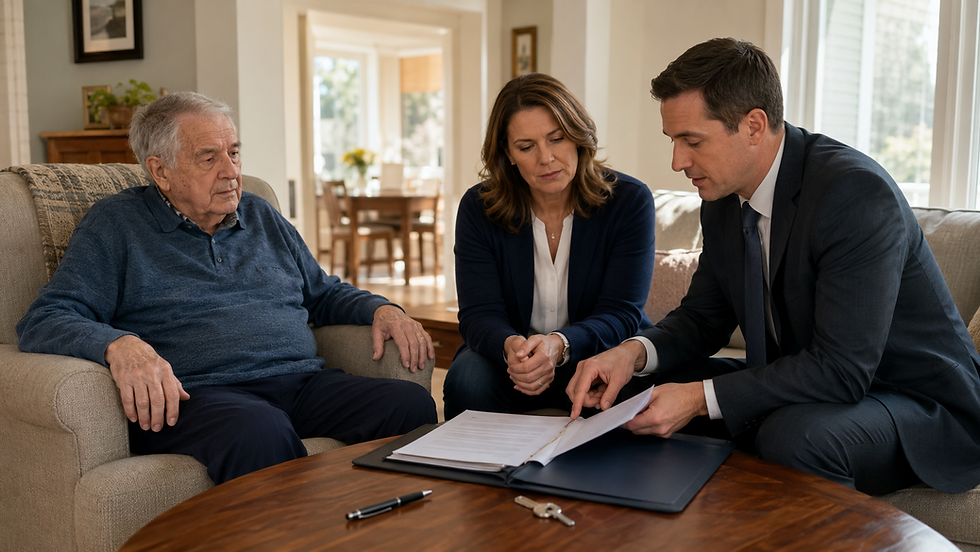
A homeowner is hospitalized, living in a care facility, or no longer able to understand legal documents. The family agrees that the house should be sold, and someone is ready to handle the paperwork.
None of that gives the family member authority to sign.
The first question is not who is willing to help. It is who has the legal authority to act for the owner. The answer depends on how the property is titled and what documents were put in place before the owner became unable to manage the transaction.
A Serious Health Problem Does Not Automatically Mean Incapacity
Physical limitations and legal incapacity are not the same.
A homeowner may be unable to travel, attend a closing, or physically sign their name while still understanding the sale and making informed decisions. New York law permits another person, under specific conditions, to sign a power of attorney at the principal’s direction and in the principal’s presence.
A diagnosis of dementia or another serious illness does not automatically establish that the person lacks capacity for every legal decision. For purposes of creating a power of attorney, the relevant question is whether the principal understands the nature and consequences of granting that authority.
Once the owner can no longer understand the transaction, a spouse, adult child, or other relative cannot sign merely because the family agrees that selling the home is necessary. Authority must come from a valid legal document or a court order.
When a Power of Attorney Can Be Used
A power of attorney allows an agent to conduct authorized financial and legal business for the principal.
Under New York law, a power of attorney is durable unless it specifically states that it terminates upon the principal’s incapacity. A properly executed durable power of attorney may therefore remain effective after the owner becomes incapacitated.
The document must still grant sufficient authority for the transaction. In New York’s statutory short form, authority over “real estate transactions” includes the power to sell and convey an interest in land, enter into a contract, execute a deed, and perform other authorized acts involving the property.
Before relying on the document, the closing attorney and title company may need to confirm that the principal signed it with capacity, the agent properly signed and acknowledged it, the relevant real estate authority was granted, and the power has not been revoked or terminated. They may also require the original document or an acceptable certified copy and determine whether it must be recorded with the deed.
A new power of attorney cannot be created after the principal has lost the capacity required to execute it. Planning must occur while the owner can understand the nature and consequences of granting authority.
A power of attorney also terminates when the principal dies. The former agent cannot continue the sale under the POA after the owner’s death. An executor or administrator generally must receive authority through the appropriate estate proceeding before individually owned property can be sold.
A Trust Changes Who Has Authority to Sign
The deed determines whether the home remains individually owned or is held in trust.
If the deed places the property in a trust, the trustee holds and manages title under the terms of the trust. The trustee, not merely the beneficiary or the person’s agent under a personal power of attorney, has authority to sell the trust property.
An agent acting under the homeowner’s personal power of attorney does not automatically acquire the homeowner’s separate authority as trustee. The POA may authorize the agent to handle the owner’s individual financial affairs, but it does not, by itself, make the agent a trustee.
New York law generally authorizes trustees to sell trust property and execute the documents needed to complete the transaction. That authority remains subject to restrictions in the trust agreement, deed, or a court order. The documents must be reviewed together before anyone signs a contract.
When the Homeowner Is Also the Trustee
Many revocable trusts name the homeowner as both the person creating the trust and its initial trustee. This allows the homeowner to continue managing the property while capable of doing so.
If that person becomes incapacitated, the trust’s succession provisions determine what happens next. A co-trustee may be able to continue acting, or a named successor trustee may be able to take over. The trust must be reviewed to determine whether co-trustees must act together, how incapacity is established, and what must happen before the original trustee ceases to serve.
Being named as successor trustee does not always create immediate authority. The person may need to obtain medical certifications, sign an acceptance of trusteeship, provide notice, or complete other steps required by the trust. If the trust does not provide an effective method for filling the vacancy, court involvement may be necessary.
The title company may request the trust agreement, amendments, proof of the trustee’s incapacity, and documents showing that the successor or remaining co-trustee has authority to sign. Resolve those questions before the home goes under contract.
When There Is No Power of Attorney or Trust
When the property remains in the owner’s name, the owner lacks capacity, and no valid power of attorney gives another person authority to act, there is no simple path forward.
Family status does not solve the problem. A spouse or adult child cannot sell the property solely because of that relationship.
A family member or another interested person may need to seek relief under Article 81 of the New York Mental Hygiene Law. The court may appoint a property-management guardian or authorize a specific transaction or protective arrangement without creating an ongoing guardianship.
Article 81 is designed to provide only the authority necessary for the person’s demonstrated needs. A court does not automatically transfer control over all of the person’s property merely because help is required with one transaction.
A Guardian Still Needs Approval to Sell the Property
Appointment as a property-management guardian does not, by itself, complete the authority needed for a home sale.
A guardian must obtain the required court approval for the real estate transaction. New York court guidance instructs guardians to comply with Article 17 of the Real Property Actions and Proceedings Law when selling an incapacitated person’s real property. The contract should be conditioned on court approval.
The proceeding may require an appraisal, notice to interested parties, a hearing, a bond, and an explanation of why the sale is in the incapacitated owner’s best interests. The order approving the transaction should identify the guardian’s authority to execute and deliver the deed and other necessary closing documents.
The guardian may also have post-closing obligations, including reporting the completed sale to the court and obtaining instructions concerning the proceeds.
This is a court-supervised process, not a substitute signature at the closing table. A family that discovers the problem after accepting an offer may be unable to meet the expected closing schedule.
Check the Deed Before Listing the House
The deed and supporting documents should be reviewed before the property is listed. That review establishes whether title is held in the owner’s individual name, jointly with another person, in trust, through an estate, or subject to a guardianship.
It can also reveal that a co-owner must participate, an agent lacks real estate authority, co-trustees must act together, a successor trustee has not completed the required steps, or court approval is needed.
Confirming signature authority before listing the home can prevent a signed contract from being tied to a seller who cannot legally complete it.
The Right Signature Depends on the Title
A family may have a sound reason for selling. The home may be vacant, carrying costs may be increasing, or the proceeds may be needed for the owner’s care. Those circumstances do not determine who can sign the contract and deed.
Authority must come from the ownership records, a valid power of attorney, the trust agreement, an estate appointment, or a court order. Each path has different documents and procedures.
Taub & Bogaty, PLLC handles residential real estate transactions throughout Long Island and New York. If an owner cannot personally sign, the firm can review the deed, power of attorney, trust, or court documents before the property goes under contract. Call (516) 531-2500 or email info@lawtb.com to discuss the transaction.


Comments